Tuesday’s Tip: Take the Roadmap Challenge (Part 2)

Well, it’s been a week since I introduced the first part of the challenge. Did you try it? How did it go? Did you notice anything about your spending habits? Were you surprised by anything? Many times we’re shocked by how much we spend. We don’t realize that those ‘little things’, the inexpensive items we buy on a whim, can actually add up to quite a bit when it happens on a regular basis. Think about what you saved in one week – and now imagine that on a slightly grander scale . . .

Which leads me to the next part of the challenge, in three steps.

Step 1: Take a good, hard look at your expense log from the past week. Is there anything you could stand to cut back on or do without? (Answer HONESTLY!!!) You may find that there are a couple of things on your list. That’s ok.

Step 2: Pick just ONE thing on your list and cut it out for the next 30 days. April 1 – 30. One month.

Step 3: Keep track of how much you save over the course of the next month.

I’m not asking you to give up every extra expense, just one. Pick one that’s the most frequent purchase. Or maybe one that’s the most unhealthy. Or the most expensive one. Whichever one you pick, do without it for the next month. On April 30, take the amount of money you saved and multiply it by 12 to see how much you can save in a year. Then ask yourself, What else could I do with that money? Pay down debt? Make an extra payment on something?? Pay something off???

Once you’ve done that, contact me and let me know what you cut out of your spending, how much you saved in a month, how much you’d save in a year, and what you learned from the experience. If you do, you’ll be entered into the contest and you could win a FREE consultation with me. You’ll get the Money Roadmap package which includes my book, a binder, and ledger paper, plus I will help you set up your own Roadmap and teach you how to use it.

There it is. The Roadmap Challenge. Try it. What do you have to lose? More importantly, what could you gain with good money management??

Good luck! I know you can do it! I can’t wait to hear from you!

Today is April 1st. Ready . . . set . . . GO!
Tuesday’s Tip: Take the Roadmap Challenge (Part 1)

Ah, Spring! Aren’t you excited? More sunshine. Longer days. Warmer weather . . . ok, I choked on that one, too. (For those of us living in the Chicago area, we’re still waiting for that last one!) But still, when I think of Spring, I think of trees budding, flowers blooming, grass greening, and I’m filled with a sense of renewal. That’s what Spring is all about, isn’t it? Things beginning anew. Fresh starts. And . . .

SPRING CLEANING!!!

When I say that, most people think of the mile-long “Honey, Do” list taunting them from the fridge door: cleaning out the closets, going through the stuff in the garage, and washing windows, to name a few. But I’m talking about cleaning in a more financial way. The concept is the same though . . . go through your stuff, keep what’s necessary, and get rid of the rest. Think of it as clearing up and reorganizing your finances.

Over the years, I’ve had many people ask me what they could do to accomplish that particular goal and my answer is always the same: Grab a pencil and paper and keep track of all the money you spend in a month, then sit down, take a very close look at it to figure out where your money is going, and determine what you need and what you can do without. (Coincidentally, it’s one of the first steps outlined in my book!!) Most of the time, the reaction is the same – jaws drop to the floor.

“A whole month?” they ask.

“Yes. A whole month,” I reply.

“That’s a really long time,” they complain.

“Yes, it is,” I say, “But it’ll give you a solid picture of where all your money is going.”

“And we have to write down ALL of it?” they ask.

“Yes. ALL of it. Every dime. Bills, credit cards, EVERYTHING you buy in CASH. ALL of it.”

Again, jaws drop to the floor. What I’ve found, however, is that everyone who was truly serious about taking control of their finances followed my advice and were astonished by what they learned at the end of that month. They also learned that, by doing away with some of the extraneous items they didn’t realize were emptying their wallets and bank accounts, they were able to save quite a bit of money. In some cases, hundreds of dollars a month. Some people even told me that after just one or two weeks of tracking their expenses, they could easily see which unnecessary items they could cut back on, or cut out completely.

Don’t believe me? Ok. Let’s consider my friend, “Lucy”, who once told me that she’s addicted to a mocha coffee concoction and has to have it every morning on her way to work. She says she wants to get a good jolt to start her day, so she orders a large. Ok. With tax, she pays $3.58. Multiply that by 5 work days. That comes to $17.90 per week. Multiply that by, say, 49 actual work weeks in a year. The total now becomes $877.10 per year. Hmm . . . I can think of a few things that I’d rather do with $877 than drink coffee . . .

Still don’t think that makes a difference? Ok. Try this one on for size. Let’s say you go out to eat two times per week. For the sake of making it easier to calculate, let’s estimate that you spend about $50 per week. $50 multiplied by 52 weeks comes to $2600 per year. I suppose if you really want to get goofy, imagine you get a mocha coffee every day AND go out to eat twice a week . . . that’s almost $3500 per year that could go toward something else. And that’s just for two people. What about a family of 3? 4? 5? It boggles the mind.

So, here’s my challenge to you: Track your extra expenses for the next week and calculate how much money you could save per month and per year by cutting back or cutting them out. I’m not even talking about bills. I’m talking about those extra things you put on your credit card or things you pay for in cash. Those dinners out. Those lattes in the morning on the way to work. Movies. Drinks with friends every weekend. Try to focus on the extra little things that you pay for fairly often. Is there a habit forming?

Now think: What would happen if you went 30 days without them? Would it make a difference in your finances? Are you willing to find out?

Stay tuned for Part 2 of the Roadmap Challenge . . .

Tuesday’s Tip: Get Those Tax Breaks!

Ok, so it’s not Tuesday. Forgive me. Let’s just call this one . . . Wednesday’s Wisdom.

With tax season in full swing, most people I know are busy gathering the necessary materials so they can file their income taxes. Some (like my hubby and I) are do-it-yourselfers and use computer software to guide us through it. Others meet with a tax professional who knows the “code” and can give advice on complicated situations. Whether you do your own taxes or have a professional deal with it, the goal is one and the same: get the biggest refund possible. In order to do that, it’s necessary to take advantage of the tax breaks that are out there for us. And with the April 15th deadline quickly approaching, it’s a good idea to find out what those breaks are. So, I’d like to share an article that I read highlighting some tax breaks that you may not have thought, or known, about that could have an impact on your tax refund. The article specifically gives hints for people at different stages of life, so keep that in mind as you read it. Not everything will apply to your particular situation, but hopefully you’ll be able to get a good idea or two. Click on the link to get started.

http://finance.yahoo.com/news/tax-breaks-every-life-stage-050001787.html

Good luck and happy filing!

Tuesday’s Tip: It Doesn’t Hurt to Ask

I’ll admit that, when it comes to bartering for a deal, I’d rather leave it to my husband. He always seems to be on the lookout for a good deal. Aren’t we all? But what sets him apart is that he finds new deals on products or services we already have and doesn’t hesitate to act if he thinks we may be getting a raw deal.

Case in point: About a week ago, he saw a commercial by our current cell phone provider offering a better deal than the one we have now. I have to say it got him a little fired up. “Are you kidding?” he scoffed. “That’s like . . . $80 less than what we pay now! Unbelievable! Maybe we should call and complain!” (Not quite the word he used, but whatever.) I told him that if he felt that strongly about it, then he should call. He should call. Not me. I’m not comfortable with that. Don’t know why. It doesn’t matter.

Anyway, after a few days, a couple more commercial sightings, and some mental number-crunching, he decided it couldn’t hurt to call and ask if we could get in on the deal. He picked up the phone and dialed. We spoke to a very nice man who told us that we could, in fact, get the same advertised price. We have 5 phones. Do we have to upgrade all the phones? Not at all. Will it affect our contract? Nope. We have automatic billing. Do we have to set that up again? No. When will the new price take effect? Immediately. So our next bill will be lower? Uh huh. So we’ll have unlimited talking and texting? Yes. And tons more data? Yep.

Alrighty, then! Do it!

And so, with one phone call (that lasted less time than being on hold) we got more for less. We’ll be saving $80 per month. That’s $960 per year. I like that. And I love that my husband took care of it all. He’s always got an eye for a good deal. Maybe it comes from being a closet conspiracy theorist or simply not wanting to get screwed over, but whatever the case, I’m glad he’s in my corner!

Tuesday’s Tip: Break the Bad

Everywhere I go, I hear new year’s resolutions being flung around as freely as candy from a parade float. People are vowing to make changes to better themselves, their lives, their communities, and even the world. However, the most common goal, by far, was to lead a healthier lifestyle, which encompasses a multitude of different options ranging from losing weight to exercising more to breaking bad habits. And that got me thinking . . .

Breaking a bad habit is tough to do. I know, first hand, how hard it is, but I also know how wonderful it feels to be successful – in more ways than one. I confess that I used to smoke. (There it is, folks.) I tried to quit several times, but always seemed to give in eventually. I was smoke-free for quite a long time before having kids and during my pregnancy, then started again when they were about 6 or 7 months old. It was easy to blame it on stress, of course. Then, when they were almost 2, I finally managed to quit altogether and have been rid of the habit for over ten years. Don’t get me wrong, there are days I seriously wonder why the heck I ever quit! Then I think about all the progress I’ve made as a runner, how much I love it, and how smoking would completely ruin it, and I decide it’s not worth it. So, you could say that I’m enjoying the health benefits of being a non-smoker.

Just recently, I noticed a sign at the corner gas station advertising a sale on cigarettes: $6.85 per pack. Wow! I couldn’t believe it. That’s a lot more than I used to spend over a decade ago. And that got me thinking about the cost of being a smoker now. What would I be paying if I were still smoking? When I got home, I grabbed a calculator and did a little experiment to find out the financial benefit of not smoking. I know the cost per pack varies depending on location, but I live in the Chicago suburbs, so I’m going to use the average for this area, which is about $7.50. Ok. Let’s see. I used to smoke about 10 cigarettes per day. That means it would cost me $3.75 per day . . . times 365 days . . . that comes to $1,368.75 per year. If I smoked a pack a day, then the cost rises to $2,737.50 per year. Really? I was amazed at the numbers starting at me from the calculator. I instantly thought of a few things I could do with an extra $2,700 per year. Then, just for kicks, I multiplied that number by 5 . . . $13,687.50 saved in 5 years. Holy cow! Then I took one step closer to ridiculous and calculated the savings for 10 years. I nearly fell off my chair! $27,375. Amazing! Do you know how much house you could pay off with that money? Or you could buy a nice little car! You could save it for a rainy day . . . or college . . . grad school . . . vacations . . . retirement . . . The list goes on and on.

And what about other costly habits? I could think of a couple. How much could people be saving by kicking those bad boys to the curb? They don’t even necessarily need to be bad for you, like smoking was, for me. What about that iced coffee on the way to work everyday? Or eating out for lunch everyday? Or even twice a week? How about takeout dinners? Shopping every weekend? Blah, ba-blah, ba-blah . . . Please understand that I’m not suggesting we all become hermits, eat ramen and rice for the rest of our lives, deprive ourselves of things we need, and never do anything fun – we gotta live, right?! The trick is to be sensible about it.

Moral of the story: breaking a bad habit, or any habit that drains your pocketbook, could potentially save you more money than you think. Don’t believe me? Pick a habit . . . do the math. See what happens. The truth lies in the numbers. Cutting out a habit, or at least scaling way back, could mean some serious extra cash in our pockets. I don’t know about you, but I like that!

Tuesday’s Tip: Set Your Credit Report Straight

Last week I wrote about our recent experience with credit card fraud. My husband and I took the necessary steps to make sure our credit, and our good names, were secure by cancelling our credit card, getting a new one, and obtaining credit reports for each of us. Then, someone who had read the post asked me what to do if something was wrong with the report . . . if there was information that was incorrect. What to do?

Well, it happens. In fact, what I didn’t elaborate on last week was that there was a discrepancy on two of my reports. When we looked at the reports, we noticed that there was a credit card listed that didn’t belong to me. Upon closer inspection, we discovered that the credit card had been opened October 1st of 1980. 1980?!?!?! How in the world could I have opened a credit card in 1980? I was 8 years old for cryin’ out loud! It was a good thing that whoever owned the card paid on time every month, but still . . . it wasn’t mine. I tried to think of any reason why this would be on my credit report, but nothing came to mind. And it made me a little nervous . . . I wanted it off my report! I called the numbers listed on the reports and asked what I should do to remove it. One representative I spoke with asked me a few questions, then simply told me it would be removed and that she’d send a confirmation email. The other rep I spoke to was really nice and even looked into it a little further for me. She told me that I was an “authorized user” on the card. I asked her what that meant. She said it meant that I had authorization to actually use the card, but that it wasn’t in my name. I wasn’t the owner. I had to laugh, then, when she told me that my maiden name was associated with the card and the last reported address on the card was my dad’s! So, I thanked her for taking care of it for me . . . and then promptly called my dad. 🙂

Moral of the story: If you get a credit report and find that something’s amiss, don’t panic – but don’t wait. Set it straight.

Experian, Trans Union, and Equifax will give you the option of disputing information you feel is erroneous. There’s a section on the credit report that informs you of your rights, how you can combat identity theft, and how to contact them if you want to file a dispute. In some cases, you can click on a button to file a claim, or you can call their toll-free number and talk to an actual person. You might find that it’s something related to a family member, like I did, or you may find that someone could be using your information illegally. In any case, it’s a good idea to get your yearly (FREE) credit reports, pay attention to anything that seems fishy, and report it immediately. You have rights. Fight for what’s yours.

Good luck!

Tuesday’s Tip: Hold It In!

With the weather in Chicago turning (much!) colder, my husband and I had our yearly conversation about how to keep electric and heating costs down this winter. Not that our bills are outrageous. In fact, ours seem to be lower than a lot of people we talk to, but it takes a little effort to keep them under control. Still, we want our family to be comfortable, so when our daughter came to us complaining that she had to pile six blankets on her bed to keep warm at night, we were concerned. Hubby and I looked at each other. The window? And not just any window. A set of three large windows, actually, that take up virtually one entire wall of the bedroom. Without a word, we both trudged up the stairs to assess the situation. Our hands hovered over every joint, edge, and seam of the windows, searching for the tell-tale draft we were sure was turning our little girl into an icicle. We couldn’t find it, but we did notice how very cold it was. The giant wall of glass provided no insulation from the cold that secretly seeped into the room.

What to do . . .

Well, way back in the day, when I was in college (and, no, I’m telling how far back) my roommate and I shared the top floor of a century-old house with windows facing every direction to the outside world. It was great when it was sunny, filling the apartment with warm sunshine. But during the winter, the wind’s icy fingers crept into our little home, making the radiators moan with the effort of keeping us warm. We asked our landlady what to do and all she offered in the way of advice was to stuff towels along the seams and hang old blankets from the curtain rods. Huh . . . yeah, ok. Sure. That’ll work. We tried it anyway, but didn’t like the fact that the blankets blocked out the natural light, making us feel like we were living in a dungeon. And it didn’t do a very good job of stopping the drafts from finding other gaps in the window sills. So, we asked our parents. They suggested putting plastic over the windows. We did, and it worked. It wasn’t perfect, but we were much warmer and, subsequently, happier knowing we weren’t going to have to take a blow dryer to our toes in the morning anymore.

So, my husband stopped by the hardware store on his way home from work the next day and picked up a package of insulating wrap. It was only about $8 or $10 and was made for large windows and patio doors. After dinner, we set out to keep our daughter from freezing while she slept. Start to finish, it took us about 45 minutes. We took down the valances and curtains, wiped the surfaces, then rolled the double-sided tape along all the edges. Next, we carefully placed the plastic around the window, trying not to make any wrinkles. Then my husband waved my hair dryer over the entire surface until the plastic was taut. Then we replaced all the curtains. Done. The next morning, our daughter gleefully informed us that she was so warm that night that she had to take off her socks and shed a blanket or two. Naturally, we were relieved and glad we wouldn’t be treating her for frostbite.

Surprisingly, the process of insulating windows with plastic isn’t very difficult. Plus, it’s an inexpensive way to block drafts and chilliness while holding the heat in, which will save you money on heating costs. You can even see through it. If you have drafty windows, but can’t afford to replace them just yet, consider installing these plastic insulating wraps to your windows. You can find them at hardware, grocery, and discount stores. (Chances are they’re on sale right now.) They also come in several different sizes with everything you need to protect your windows, including instructions. You supply the hair dryer. It’s an easy, inexpensive alternative to freezing to death or going broke.

Tuesday’s Tip: Keep Your Balance!

When people ask me about my book and what it does, I tell them that it’s a kind of ‘workbook’ that’s designed to help them set up their very own Roadmap and learn how to effectively manage their money. How? they ask. I say that it asks them to take a good, hard look at how they spend their money, to set priorities (goals) for themselves, and to stick with it. The book teaches them how to do these things as well as how to set up their Roadmap and how to use it on a regular basis. It helps them keep track of their money – where it’s going, where it needs to be, and what to do with the rest. Sometimes the next question that comes up is How do you know how much money you’re supposed to start with? I then explain that they’ll start with whatever amount is in their account – which is usually followed up by How am I supposed to know how much is in my account? And I say, Well, you’ll need to balance your checkbook.

It’s then that I fear I’ll have to use CPR. They inhale sharply, their hands fly to their chests, their eyes widen, and their mouths gape in horror at the mere thought of having to balance their checkbooks. I reach out to them. I try to steady them with a calming hand on the arm. Occasionally, I have to remind them to breathe . . .

As terrifying as it may sound, balancing your checkbook is one of the first, necessary, steps to setting up your Roadmap and getting control of your finances. You have to make sure all of your debits (outgoing money) and credits (incoming money) are completely accounted for, included in your checkbook, and the balance matches what the bank says you have. This can be particularly difficult if you’ve never balanced your account before, or if it’s been a really long time. But in all honesty, once that’s done, it’s much easier to keep up with it if you balance every time you get your statement. (And if you’re not sure how to do it, there are usually instructions on the back that walk you through it!)

Having a current and accurate balance is needed when setting up and using your Roadmap, but it’s also incredibly important to note that it will also help you find any discrepancies, mistakes, or unauthorized use of your account. In this day and age of identity theft, you can’t be too careful with your money! No one at the bank is monitoring your account, and the computer simply spits out your statement, which means it’s up to you to be on top of it. And the best way to do that is to keep your balance up to date and accurate.

I’ve had many, many conversations about money management and finances, and I can tell you right now that one of the most important, and simplest, things you can do for yourself is to keep track of your money on a regular basis. Balance your checkbook every month, keep your Roadmap updated, and once you get the hang of it I’m certain some of that anxiety will start to slip away and you’ll feel much better knowing that you’re in control. It’s a balancing act, but I know you can do it.

Tuesday’s Tip: It’s in the Cards

I recently went out for breakfast with my friend, Jill, and as I settled into the booth, she slid an envelope my way. I smiled, picked it up, and asked her what this was for. She smiled back and wished me a happy birthday. I was touched by her thoughtfulness and I’m sure I blushed a little. For as often as I insist that my birthday is ‘just another day’, that I still have to get up, take care of my kids, do laundry, cook, clean, go to work, or do whatever it is I need to do – it always warms my heart when someone recognizes it. Even if just to say the words.

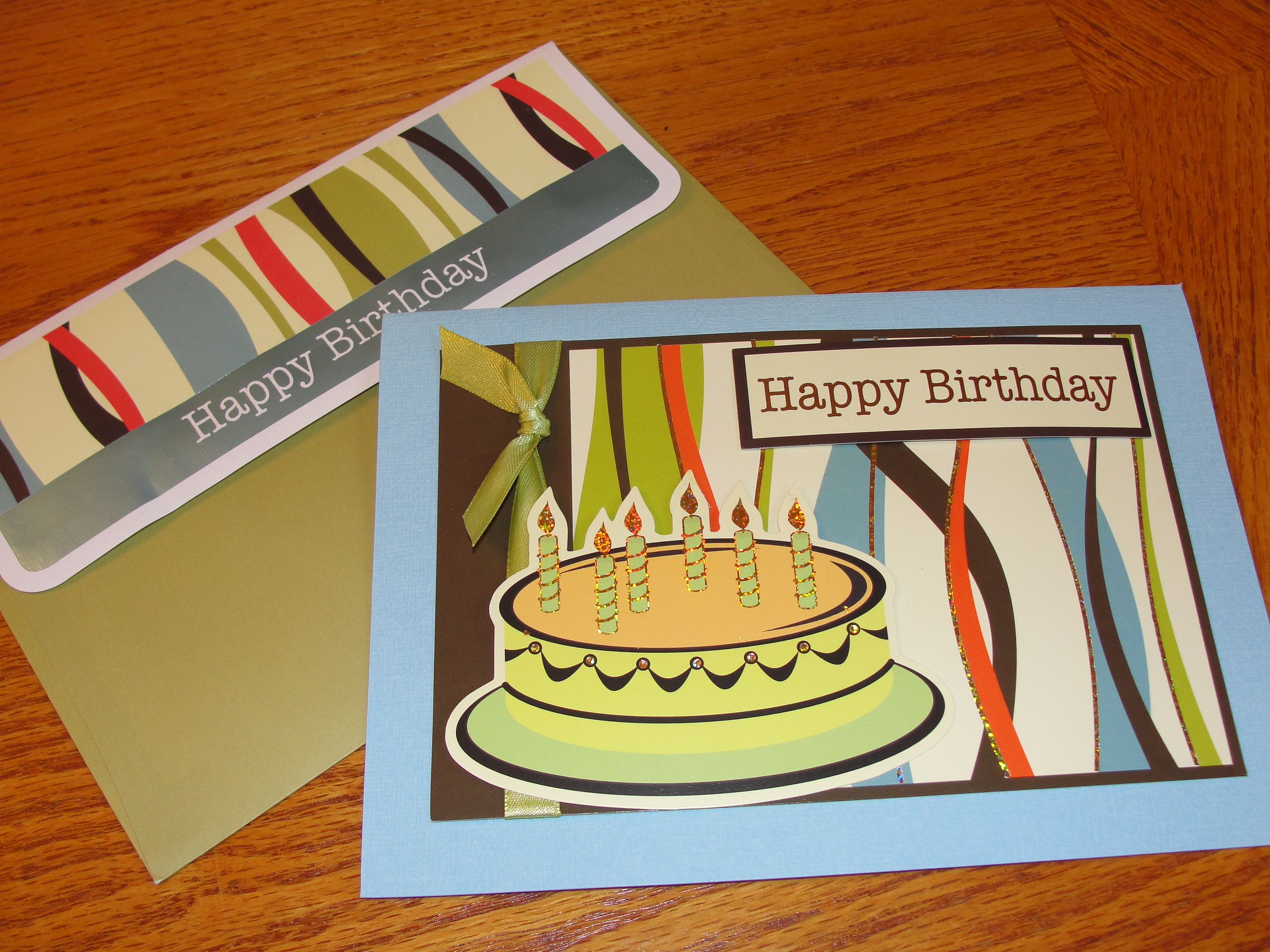
I thanked her and took the card in my hands. The envelope looked fancy. It had a birthday cake on the front and some retro curvy stripes on the flap. ‘Happy Birthday’ was even embossed on blue foil. I opened it up. The card itself was made of heavy blue paper, the kind used for scrapbooking, adorned with appliqués of those retro stripes and matching ribbon, ‘Happy Birthday’, and a cake with sparkly candles. It was so pretty! Inside, the message read, “Wishing you a happy birthday”. She added a personal note that made me laugh out loud. (No, I’m not going to share it with you here – it’s personal!)

Birthday Card

It really was a beautiful card and it looked handmade, so I asked her if she’d created it. That’s when she gave me that sheepish grin of hers and confessed her little secret: it was one of many greeting cards included in a large box set that she bought at a wholesale club store.

My jaw dropped. She laughed. Then she proceeded to explain that she’d discovered one of these sets a few years ago and that it was different every year. It contained cards for just about every occasion you could think of: anniversaries, weddings, babies, birthdays, sympathy, and even thank you cards. She couldn’t remember exactly how many were in the box or how much it cost, but according to her estimate, the cards averaged out to less than $1 per card. Again, my jaw dropped. Considering we readily pay $2 . . . $3 . . . $4 per card at the grocery store or a gift store, this was a great find! I couldn’t believe it! (I also made a mental note to look for it the next time I was there . . .)

Long story short . . . I was incredibly touched by the simple, yet heartfelt gesture of my dear friend. She didn’t have to give me a card for my birthday, but she did – and I felt loved. It reminded me that something as simple as a birthday wish could bring so much joy to a person’s life. We’re all busy. It’s hard to find time to give the kind of attention our friends and family deserve. But the small gesture of a card to say, “I’m thinking of you” could just make someone’s day . . . or week . . . or month . . . you get the picture.

And it doesn’t have to cost a fortune! ;D