Tuesday’s Tip: Keep Your Balance!

When people ask me about my book and what it does, I tell them that it’s a kind of ‘workbook’ that’s designed to help them set up their very own Roadmap and learn how to effectively manage their money. How? they ask. I say that it asks them to take a good, hard look at how they spend their money, to set priorities (goals) for themselves, and to stick with it. The book teaches them how to do these things as well as how to set up their Roadmap and how to use it on a regular basis. It helps them keep track of their money – where it’s going, where it needs to be, and what to do with the rest. Sometimes the next question that comes up is How do you know how much money you’re supposed to start with? I then explain that they’ll start with whatever amount is in their account – which is usually followed up by How am I supposed to know how much is in my account? And I say, Well, you’ll need to balance your checkbook.

It’s then that I fear I’ll have to use CPR. They inhale sharply, their hands fly to their chests, their eyes widen, and their mouths gape in horror at the mere thought of having to balance their checkbooks. I reach out to them. I try to steady them with a calming hand on the arm. Occasionally, I have to remind them to breathe . . .

As terrifying as it may sound, balancing your checkbook is one of the first, necessary, steps to setting up your Roadmap and getting control of your finances. You have to make sure all of your debits (outgoing money) and credits (incoming money) are completely accounted for, included in your checkbook, and the balance matches what the bank says you have. This can be particularly difficult if you’ve never balanced your account before, or if it’s been a really long time. But in all honesty, once that’s done, it’s much easier to keep up with it if you balance every time you get your statement. (And if you’re not sure how to do it, there are usually instructions on the back that walk you through it!)

Having a current and accurate balance is needed when setting up and using your Roadmap, but it’s also incredibly important to note that it will also help you find any discrepancies, mistakes, or unauthorized use of your account. In this day and age of identity theft, you can’t be too careful with your money! No one at the bank is monitoring your account, and the computer simply spits out your statement, which means it’s up to you to be on top of it. And the best way to do that is to keep your balance up to date and accurate.

I’ve had many, many conversations about money management and finances, and I can tell you right now that one of the most important, and simplest, things you can do for yourself is to keep track of your money on a regular basis. Balance your checkbook every month, keep your Roadmap updated, and once you get the hang of it I’m certain some of that anxiety will start to slip away and you’ll feel much better knowing that you’re in control. It’s a balancing act, but I know you can do it.
Tuesday’s Tip: It’s in the Cards

I recently went out for breakfast with my friend, Jill, and as I settled into the booth, she slid an envelope my way. I smiled, picked it up, and asked her what this was for. She smiled back and wished me a happy birthday. I was touched by her thoughtfulness and I’m sure I blushed a little. For as often as I insist that my birthday is ‘just another day’, that I still have to get up, take care of my kids, do laundry, cook, clean, go to work, or do whatever it is I need to do – it always warms my heart when someone recognizes it. Even if just to say the words.

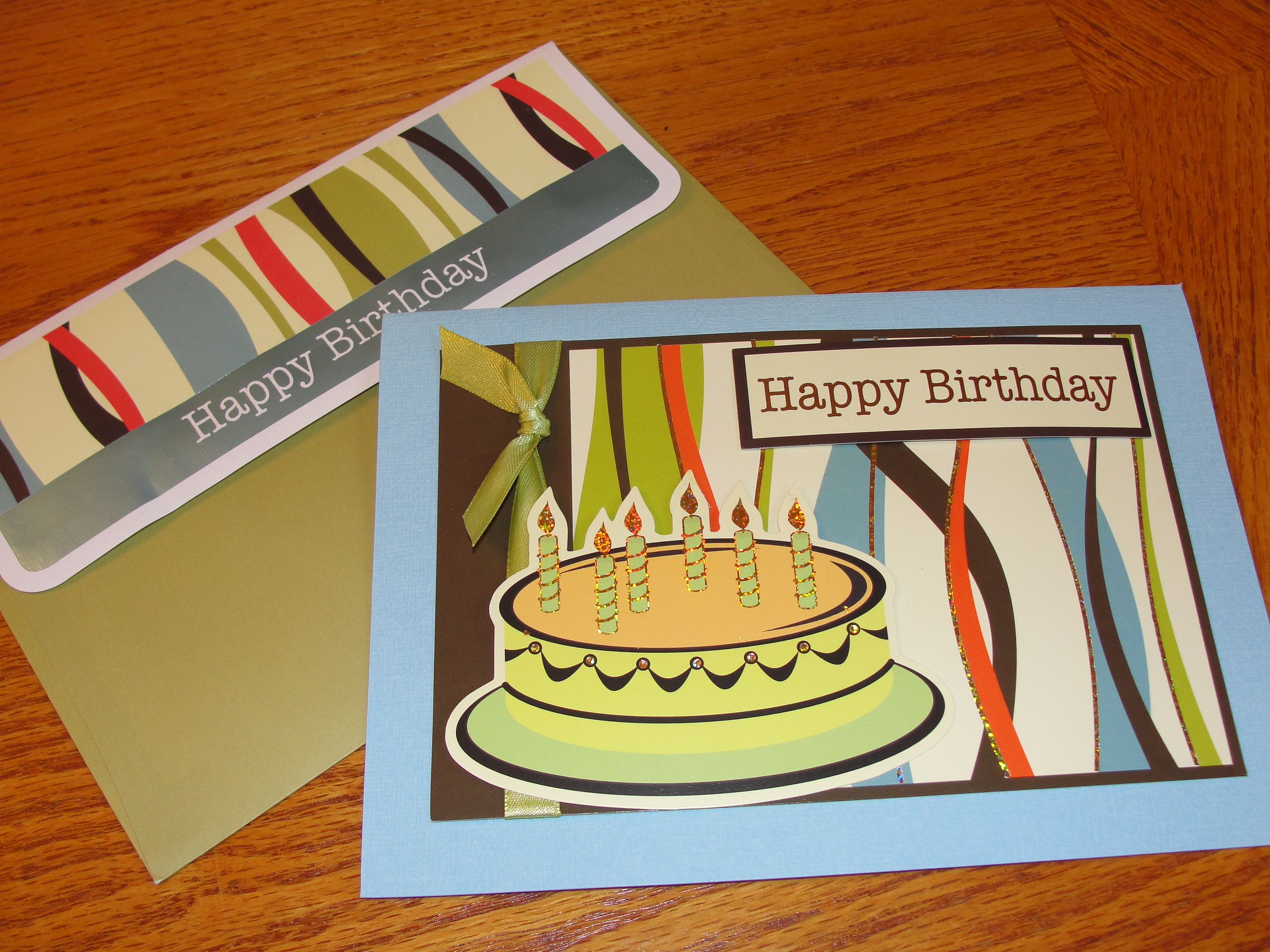
I thanked her and took the card in my hands. The envelope looked fancy. It had a birthday cake on the front and some retro curvy stripes on the flap. ‘Happy Birthday’ was even embossed on blue foil. I opened it up. The card itself was made of heavy blue paper, the kind used for scrapbooking, adorned with appliqués of those retro stripes and matching ribbon, ‘Happy Birthday’, and a cake with sparkly candles. It was so pretty! Inside, the message read, “Wishing you a happy birthday”. She added a personal note that made me laugh out loud. (No, I’m not going to share it with you here – it’s personal!)

Birthday Card

It really was a beautiful card and it looked handmade, so I asked her if she’d created it. That’s when she gave me that sheepish grin of hers and confessed her little secret: it was one of many greeting cards included in a large box set that she bought at a wholesale club store.

My jaw dropped. She laughed. Then she proceeded to explain that she’d discovered one of these sets a few years ago and that it was different every year. It contained cards for just about every occasion you could think of: anniversaries, weddings, babies, birthdays, sympathy, and even thank you cards. She couldn’t remember exactly how many were in the box or how much it cost, but according to her estimate, the cards averaged out to less than $1 per card. Again, my jaw dropped. Considering we readily pay $2 . . . $3 . . . $4 per card at the grocery store or a gift store, this was a great find! I couldn’t believe it! (I also made a mental note to look for it the next time I was there . . .)

Long story short . . . I was incredibly touched by the simple, yet heartfelt gesture of my dear friend. She didn’t have to give me a card for my birthday, but she did – and I felt loved. It reminded me that something as simple as a birthday wish could bring so much joy to a person’s life. We’re all busy. It’s hard to find time to give the kind of attention our friends and family deserve. But the small gesture of a card to say, “I’m thinking of you” could just make someone’s day . . . or week . . . or month . . . you get the picture.

And it doesn’t have to cost a fortune! ;D

Tuesday’s Tip: Renewal Screwal

In an effort to save some money, my husband and I are very picky about our magazine subscriptions. We only get those that cater to our specific interests, and we decided that, if they no longer serve their purpose, we let the subscription expire. As it is, we only get three: scientific for him, running for me, and one for the whole family that focuses on current events. We used to have four, but I was getting a little tired of the same thing month after month and got bored. I mean, how many times can I make myself over, overhaul my happiness quotient, and un-clutter my life in one year?

Anyway, one day, my husband got a postcard in the mail from the current events magazine. We were in the kitchen – I was making dinner and he was going through the mail – when I heard him chuckle. Not the kind of chuckle he makes when he thinks something is amusing, but a kind of cynical chuckle. Like an “unfunny” kind of chuckle.

“What’s up?” I asked.

“Hmm,” he began. He flipped the card over, then back again. Then he quoted, “This is just a reminder that your subscription is about to expire. But no need to worry! Because you have opted for our convenient auto-renewal program, no action is required. We’ll simply charge your credit card $45 and delivery will continue as usual, with no interruptions. Should you have any questions about your subscription, please visit blah, blah, blah dot com, or call 1-800-blah and our team will be happy to assist you.”

I paused, mid-stir, and frowned. “Ok,” I said, not quite understanding what the exact nature of the problem was. So I asked, “I don’t understand. Is that not good?”

“Um, no,” he replied. “Especially since I only paid $20 for the subscription in the first place. Now they want to charge us $45 for another year?”

“Oh my,” I said. (Not really, but this is a tasteful blog.) “That’s more than double. That’s . . . that’s . . .”

“Stupid,” he finished my sentence. He proceeded to disappear to the computer room, then returned just a few minutes later and told me that the magazine’s website is offering the same exact subscription for $30. “Why should I let them charge me $45 when their website is offering it for $30?” he asked. I shrugged. I couldn’t think of a reason. Then he disappeared again, this time taking the phone with him. He returned a few minutes later, with that disgusted look on his face, put the phone on its cradle rather forcefully, and informed me that we were no longer going to get the magazine. Ok.

“Ok,” I said. “Why?”

“Because the guy I talked to said he couldn’t just lower the price for me. In order for us to get it for $30, we’d have to cancel our current subscription, then go online and sign up for it again, which means entering all our information again even though we already have a subscription.” He rolled his eyes and shook his head. “It’s not worth the hassle.”

So I guess we’re down to two magazines now.

Moral of the story? It’s twofold, actually. First, if you have magazine subscriptions, make sure you pay close attention to how much you paid, initially, for the subscription and how much your renewal will cost you. I’m not against paying for goods and services. Hey, people work hard and should be paid for their efforts, but don’t screw me over by charging me double (or more) for the next round! Charge me a fair price, treat me well, and I’ll be loyal. Secondly, automatic renewal is incredibly convenient – something I secretly love – however it’s also a marketing gimmick. Companies are counting on consumers to either forget how much they paid for the initial deal, or be so grateful that they don’t have to send something in by a certain date to continue service that they don’t pay attention to how much they’re being charged, or they’ll forget that they need to cancel by a certain date in order to not get charged. Or all three!!!

So do yourself a favor and be a savvy consumer. Pay attention to what you pay for things. Check the prices. Ask questions. Don’t be afraid to say ‘no’ to something you don’t think is fair. (But be reasonable, too!) Chances are companies will work with you to get you a good deal so you’ll stay. It’s win-win.

Tuesday’s Tip: Mix and Match

I recently accepted a new job . . . one in which I need to dress very professionally. Granted, it’s part-time, however I still need to wear appropriate clothing. And that gave me a bit of anxiety. Being a mom, camper/hiker, runner, and outdoor education guide, my dress code has been, to say the least, incredibly casual. So, I ventured into my closet to find out what suitable clothes I had that still fit me. (Ugh.)

As anal retentive as I am, I began organizing everything by item, i.e. pants, skirts, blouses, etc., and evaluating each, asking myself a few key questions: Was it old? Did it look old? When was the last time I wore it? Did I like it anymore? If the item survived that round, I tried it on. If it didn’t fit, I got rid of it. If it did, I put it back on the hanger and put it with the rest. What resulted was this: a few dress pants in black, brown, navy, and one gray . . . a couple of blouses, both long and short-sleeved . . . some nice sweaters . . . a couple of blazers . . . and a few dresses and skirts. The good news was that I had enough shoes to match whatever I wore, so that was a plus. But my dressy wardrobe was, admittedly, a little on the thin side. I sighed.

That’s when my hubby walked in. He saw me, hands on my hips, examining my clothes and asked what the heck I was doing. “Trying to find out how much I have for my new job,” I replied.

He nodded his understanding, stood next to me for a few seconds, also evaluating my wardrobe, and then said, “Doesn’t look like a whole lot. Do we need to go shopping?”

I rolled my eyes and stuck out my tongue. “Oh, ick!” I know, real mature, but there are two reasons for that: 1) I really, really don’t like shopping, and 2) I didn’t want to spend a bunch of money on a part-time job until I had a better idea of where it might lead.

Hubby just shrugged his shoulders and said, “I know, but if you need some new clothes, then let’s go buy some for you. Besides, I need a few pairs of pants. Some of mine are getting ratty,” he explained as he touched the cuffs on his side of the closet.

“Well, let me see what I can do,” I said, not ready to hit the stores just yet. I had an idea . . .

I began looking at colors. Then I looked at style and season. I discovered that a few of my outfits had two parts, i.e. a dress with a matching jacket, and realized that if I split up the parts and paired them with something else, I created a whole different outfit. Suddenly, I saw that this blazer could be paired with those pants and that blouse, or that skirt goes with this top and that sweater. The little jacket that goes with that dress would look really cute with this shell and these pants. Wow! Then I hit a snag. These two skirts don’t have any tops that match. Hmmm . . . I may have to go shopping – but only for a few basic things. And if I get them in colors that go with everything else, then I’ll have even more options!

The point is, when you’re short on money or don’t want to spend a lot on clothes, there is a way: mix and match. If you’re not sure how to do that, here’s a tip. Look at the colors in your closet. What do you see? Chances are you see a lot of items in similar colors or in colors that you like and that look nice on you. Now, do you see any full outfits or ones with two or more “parts”? Separate them. Take that bolero jacket and see if it goes with anything else. Does that blouse look good with a few different pairs of pants? How about that sweater? Will it go with those pants or this skirt?

And you men out there, don’t think this only applies to women. You can do it, too. You probably have pants in different colors that can be paired with different shirts. Try switching it up once in a while. Instead of wearing the green shirt with the tan pants all the time, try the pants with that cool rust colored shirt, or the blue one. How about the bold plaid shirt with those black pants? Or the red striped shirt with the navy pants? Go nuts. Try it.

And the next time you go shopping for clothes, take into consideration the different combinations you can make with what you’re tossing into your cart. Buy things in similar colors or patterns so that you can mix them up later. There’s no need to buy outfits that should always be worn together. They say that variety is the spice of life. I say that’s true. But I also say it doesn’t have to cost you a fortune.

Tuesday’s Tip: Find the Freebies

The other day, someone mentioned my post about buying memberships, but hinted that it’s not exactly feasible for her and her family at the moment and asked me if there was something else I could recommend. There is one thing . . .

FREEBIES!

During certain times of the year, including summer, holidays, and slow months, there can be a multitude of specials the whole family can enjoy. Here are a few tips:

1) Check out coupon sites online. There are lots of sites that have things like buy 1 Get 1 sales or free products and services – just be sure to do a little research first and pick the sites that offer things you like to do.

2) Check websites of your favorite museums. Many times they’ll offer free admission on certain days of the week. Usually it’s midweek, or a day that’s typically slow for them. If you can manage a day off, it’s worth it. There’s less traffic and smaller crowds to deal with!

3) Many communities are now offering events like ‘Movies in the Park’ or summer festivals that offer free admission. Sometimes you can even bring your own food and picnic there.

4) Research places that offer free things for students. You’d be surprised how many places will give kids a price break if they bring their student ID!

5) Last, but not least, check out websites for free things to do in your area or a closer, major city. Type something like free things to do in fill in the city name here and see what happens.

The point is, you can have a good time without completely emptying your wallet. If a membership isn’t in the cards for you right now, that’s ok. But you don’t have to stay at home everyday wondering what to do to keep your kids from murdering each other. Yes, it takes a little bit of effort, but here’s another tip: if you’re part of a social network, see what you’re friends are up to, what they’re doing, and where they’re going. You might find some good ideas and great deals.

Happy summer!

Tuesday’s Tip: Membership Pays

Well, summer has officially begun! It’s the time of year we dream of during the cold, winter months when the skies are bleak and gray. It’s a time that brings about cherished memories of summers past. A time we eagerly anticipate as the world begins to thaw and spring to life once again. A time to venture out of our homes, to explore the wonders that surround us . . . but do you ever find yourself wondering: What should we do? There are so many different options during the summer months but, while we’d like to do all of them, there just doesn’t seem to be enough time . . . or enough money.

So consider this: a membership.

If there’s a particular place you enjoy visiting, or a certain activity you engage in frequently, then you may want to consider becoming a member. But the cost of membership seems so expensive! you might think. It’ll never pay for itself. Ok. Valid concern. Let’s take a closer look at it . . .

Let’s say you love going to the zoo. You have a family of 5. To park your car, that’ll cost $10. General admission is $30 for 2 adults, and $31.50 for your 3 kids under age 11. The subtotal, so far, comes to $71.50 – just to walk in the gate. Now your kids are begging you to see the dolphin show. That’s another $7.50. Oh! And there’s a super cool special exhibit, for this summer only, that your kids are dying to see. That’s an additional $19. That brings our total to $98. And now they’re thirsty. And hungry. And there’s an awesome something-or-other at the gift shop that only costs $10 . . .

Oh! I’m sorry . . . is your head spinning? Breathe. Take deep breaths. In through your nose. Out through your mouth.

Ok. Same scenario – but as a member. The cost of a family membership is $115. That includes unlimited admission and parking for a year, plus a free guest, 4 tickets to the dolphin show, 4 tickets to ride the tram, some free passes you can give to your family or friends, admission to the children’s play zoo, and discounts on everything from food to merchandise to special events and exhibits. So, if we do a little math (don’t panic!) we see that, even if you choose to simply walk around, skip all the extras, and buy absolutely nothing, the total cost of 2 visits is $143 – which means the membership will have already paid for itself. If you return several times throughout the year, you’ll save hundreds of dollars just in admission and parking fees alone. For example, if I paid $71.50 for each of 5 trips to the zoo, I’d pay a total of $357.50. If I buy a zoo membership for $115, I’d save $242.50 over the course of the year. Want to get really nuts? $115 divided by 5 visits means that the cost per visit would only be $23. For the whole family. That’s a lot better than $71.50.

What else can you do? Who else offers deals and memberships? Ask around. Look up your favorites online. If you enjoy swimming, check out the cost of a pool pass. Do you like museums? How about amusement parks? Or maybe camping? Local sporting events? Golf? Whatever the case may be, do a little research. Find out what’s included in the cost, what the perks are, and if it’s something worth doing. Calculate how much it would cost you for multiple visits and then compare it to the cost of a membership. Or, you can take the cost of the membership and divide it by the number of visits you could realistically make and see what the cost per visit is. Either way, you may just find that being a member can be a very economical way to do the things you enjoy most.

My First Seminar

I’m looking forward to my very first seminar! I’ll be giving pointers on how to save money, set priorities, and answer some budgeting questions from participants. If you’re in the Chicago area, and you’re interested in taking control of your finances, go to www.plainfieldpubliclibrary.org for more information and sign up. I’ll be there this Saturday, April 27 at 10:00 a.m. – and I’ll also have copies of my book for sale. Hope to see you there!

Tuesday’s Tip: Invest for Your Future

As the last post regarding what to do with your tax refund, I’d like to suggest beginning to set aside some money for you. I’m assuming that you’d rather not work until you’re 96, so now is the time to stash away some cash for your retirement. Some of you may think ‘Oh, I’m too old to start saving for retirement’, or ‘I can barely get by on a daily basis, how the heck am I going to save for the future?’. Well, guess what? It’s never too late. And if  you’re in a pickle, financially, then it’s time to fix up the engine so you can get behind the wheel and go where you’d like to go.

If you participate in a retirement savings program through your company, like a 401(k), good for you. That’s fantastic. But to be honest, I wouldn’t necessarily count on that as your sole source of income after you retire. In this day and age, you need to cast your net a little wider to ensure you don’t have to eat peanut butter and jelly for the rest of your life.

There are several different coffee cans to toss your spare pennies into, like bonds, CDs, mutual funds, stocks, money market accounts, IRAs, and such. (I’m not going to give you any kind of advice about which ones are performing well or suggest that you buy into any one fund or stock. I’m merely pointing out that you have options.) These types of investment opportunities are separate from a company-sponsored 401(k), so it’s up to you to decide how much money you want to invest – and then you make the deposits. You can do that monthly, quarterly, yearly – whenever you have some extra cash to throw at it. That’s why I suggest using your tax refund money to get you started. If you don’t need it, why not put it to good use? But let me throw in a word of caution: if you’re going to make this one of your priorities, make sure that you keep up with it. There’s no sense in opening an account if you’re never going to contribute to it.

If this sounds like something you’d be interested in doing, then hop on the computer and do a little research. Visit the websites of different investment firms in your area, find out what they have to offer, and then make an appointment. A professional financial planner can answer any questions you may have and will give you advice about the best places to put your hard-earned cash.

And just so you know – he or she will probably ask you what your goals (a.k.a. priorities) are in life. Maybe now would be a good time to brainstorm . . .

Tuesday’s Tip: Invest in Your Home

If you own your home, you know that the projects seem to be never-ending. There’s always something that needs to be fixed, painted, or replaced. Things wear out. It happens. But the real problem comes when you have to scrounge up enough money from somewhere to buy a new water heater because your old one unexpectedly handed in its resignation all over your floor. The trick is to have some money on hand for The Unfortunate. You may not have a lot to spare, but earmarking some is certainly something to think about doing so you’re not panicking if an emergency arises.

But what about the things you’re planning to do? Maybe you’d like to get new kitchen appliances . . . or new flooring . . . or new furniture . . . or you need to paint a few rooms . . . the list can go on and on. If you’re eyeing that fridge you saw in the ad, then grab a calculator and do a little math. How much is it? How much is it on sale? How much do you need to set aside each month (or paycheck) so that you can buy it in 3 months? 6 months? Do you need new carpet in the family room? Measure the room. Find the square footage. Shop around and compare prices. How much would it cost to carpet the room? How much do you need to save each month to have it installed in 4 months? 8 months? A year? Do they offer some favorable financing? Or maybe a deal offering no interest, no down payment, etc.?

If you’re contemplating a home improvement project, do a little research and little investigating. Look into different types, models, prices, value, or selection. Be on the lookout for sales and discounts. Then, do the math. One of the principles of The Money Roadmap is to set aside a predetermined amount of money for each of your priorities on a regular basis so that it’s there when you need it. If you do your detective work, then you’ll have a much better idea of how to accomplish your goal. If it’s something that can be achieved with your refund alone, then give it some serious thought. If it’s a more expensive endeavor, then use some of your tax refund to get started, then add to it regularly until you’ve met your goal. Consider it a sort of ‘down payment’ on what you’re working toward.

Your home is your living space . . . work space . . . family place . . . hiding place . . . you name it. So put your money to good use and make it yours.

If you’re interested in learning more about how to have more control over your money, check out my book The Money Roadmap: You choose the destination AND the way! Good luck to you! You know where to find me if you have any questions!

Clearance Cash-in

In light of the outdoor environment of my new job as an Education Guide, I decided I needed to get a coat that would withstand the elements. I had an unused gift card from Christmas, a 20% coupon, and a little extra time, so I went shopping. (Which is not my forte, by the way.) I, luckily, found exactly what I wanted right away – a 3-in-1 system jacket in an awesome, bold green color. I noticed that it was on clearance for $40, originally $200. Wow! Ok. I’m liking this . . .

But my gift card was for $50. Hmm . . .

So I went to another section of the store and took a peek at the clearance racks. (Also something I am not good at – ick!) But I figured I could use some sturdy pants or maybe a shirt or two that would be appropriate. I found two pair of cargo pants, but alas, they were too big. Then I couldn’t find any others in my size. Bummer. But as I quickly scanned the racks for colors I liked in fabrics that were suitable, I found four shirts. Also on clearance. One was $7.20, another was $4.80, and the other two were $3.20. Ok . . . I was done. I didn’t want to overdo it.

I got to the register. I placed my items on the counter and the very nice cashier began ringing everything up. I handed over my 20% coupon and my $50 gift card. I nearly fell over when she told me how much I owed . . .

69¢

As I stood there in stunned silence, she smiled at me, handed me the receipt, and cheerfully told me I had just saved $225.28. “Have a nice day,” she said with a smile. I picked up my chin, managed a “Thank you. You, too,” and moved forward, quickly checking to make sure I hadn’t drooled all over the counter. I checked the receipt just to make sure I wasn’t hallucinating, then smiled.

Yes, I think I will have a nice day . . .